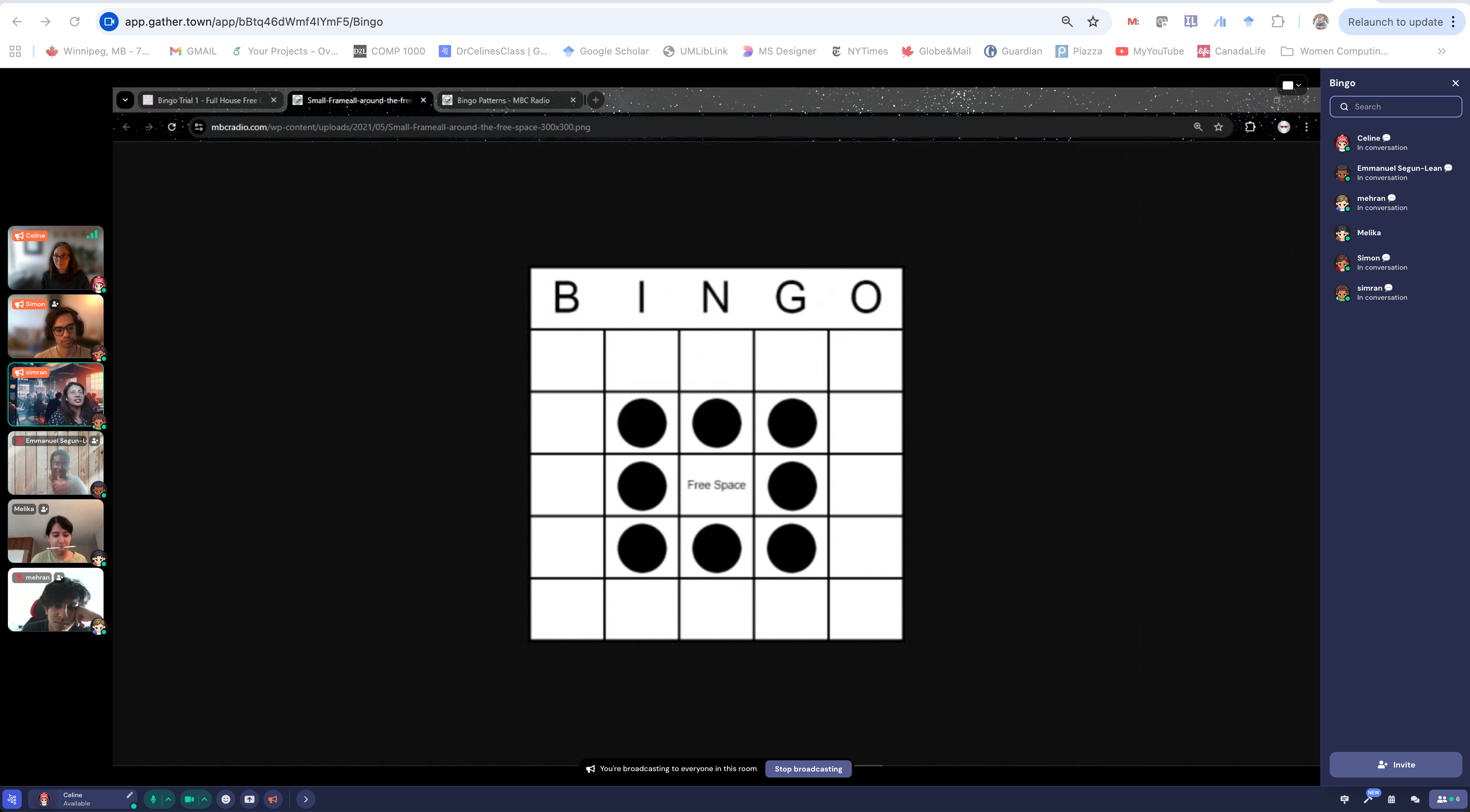
This interview study investigates the perceptions of bingo experts (bingo hall organizers and bingo callers) as well as older adult bingo players (age 50+) about using a virtual world platform to host bingo events. We are interested in learning about barriers that may prevent older adults from wanting to try out or make use of an online platform for socializing while playing bingo. By understanding the barriers to online social bingo participation for older adults, software developers may be able to design online social bingo platforms in the future that older adults will be willing to try and use.
Recruitment Script
Investigators:
Dr. Celine Latulipe (celine.latulipe@umanitoba.ca)
Simran Panthi (panthis@myumanitoba.ca)
You are invited to participate in a research study that aims to understand barriers that may prevent older adults from participating in online bingo events. Participants will receive $25 as a thank-you for their time. This compensation is given by e-transfer or e-gift card to Tim Hortons. Participation in this study involves one interview lasting up to one hour.
Eligibility
You may take part in this study if you are:
- A bingo player aged 50 years or older, or
- A bingo organizer or caller aged 18 years or older
- Willing to be audio-recorded
You can choose to participate in-person or online.
For online interviews, participants should have access to a desktop or laptop computer with a microphone so that they can participate via Zoom. In-person interviews can be held at a location convenient for the participant (community centre, library, coffee shop, or on campus at Fort Garry).
During the interview:
- You will be shown short videos of a virtual bingo game designed using a platform called Gather
- You will then be asked questions about your thoughts, concerns, and perceived barriers related to participating in the online platform shown in the videos.
Data Security
The interview will be audio recorded and then transcribed, and any identifying information will be removed from the transcript. Interview recordings and transcripts will be stored securely on University of Manitoba servers and only available to the project researchers. Quotes from interviews may be used in research publications and presentations, but quotes will be anonymized (e.g., “P3 described …”).
Benefits & Risks
There are no direct benefits to participating in this research. This research may help with the development of future online bingo platforms that reduce participation barriers for older adults. The risks to participating in this study are no greater than in everyday life.
Consent
To take part, you will need to read and complete a consent form. Once we receive your completed form, we will contact you using the email address or phone number you provide.
(Consent forms removed as study is over)
Participation in this study is completely voluntary. You may withdraw at any time, including during the interview, without penalty.
This research has been approved by the University of Manitoba Research Ethics Board, Fort Garry Campus. If you have any concerns or complaints about this project, you may contact any of the above-named persons or the Human Ethics Coordinator at 204-474-7122 or humanethics@umanitoba.ca.
Research Summary
As part of this study we interviewed 19 participants, 13 older adults and 6 bingo experts (bingo caller or organizers). From our detailed analysis of our interview results, we learned the following:
Participants’ relationships with technology varied widely, from daily, confident users to those who avoided it entirely. Cybersecurity and fraud concerns were nearly universal, and many participants relied on family members or paid services to manage their devices and keep themselves digitally safe.
Bingo, for most participants, is primarily a social activity. They described it in terms of community, friendship, and a regular reason to get out of the house. Money mattered too, but for most participants it was secondary, framed as a bonus rather than the reason they attend. A smaller group placed money first and made clear that without monetary prizes, attendance would drop sharply.
Direct experience with online bingo was limited, mostly to Kinsmen Bingo during the COVID-19 pandemic. Participants without online experience preferred in-person bingo strongly and could imagine playing online only under specific conditions, such as illness, mobility limitations, or weather. The bingo experts offered mixed views, some appreciating the accessibility online formats provide, and others worried about overspending or competition with their own halls.
Reactions to the Gather virtual bingo space we presented (as a video during the interviews) were positive on specific features such as avatars, proximity chat, and the shared number board. At the same time, participants raised concerns that the platform looked oriented toward younger users. Several barriers to playing bingo online recurred across participants: a preference for the in-person experience, lack of access to devices, perceived demographic mismatch, and concerns about how winnings would be paid and verified.
Taken together, these findings indicate that an online bingo platform aimed at older adults must center the social experience that draws them to bingo in the first place, address trust around payment as a deliberate design concern rather than an afterthought and treat the learning curve as a shared rather than individual challenge.

